
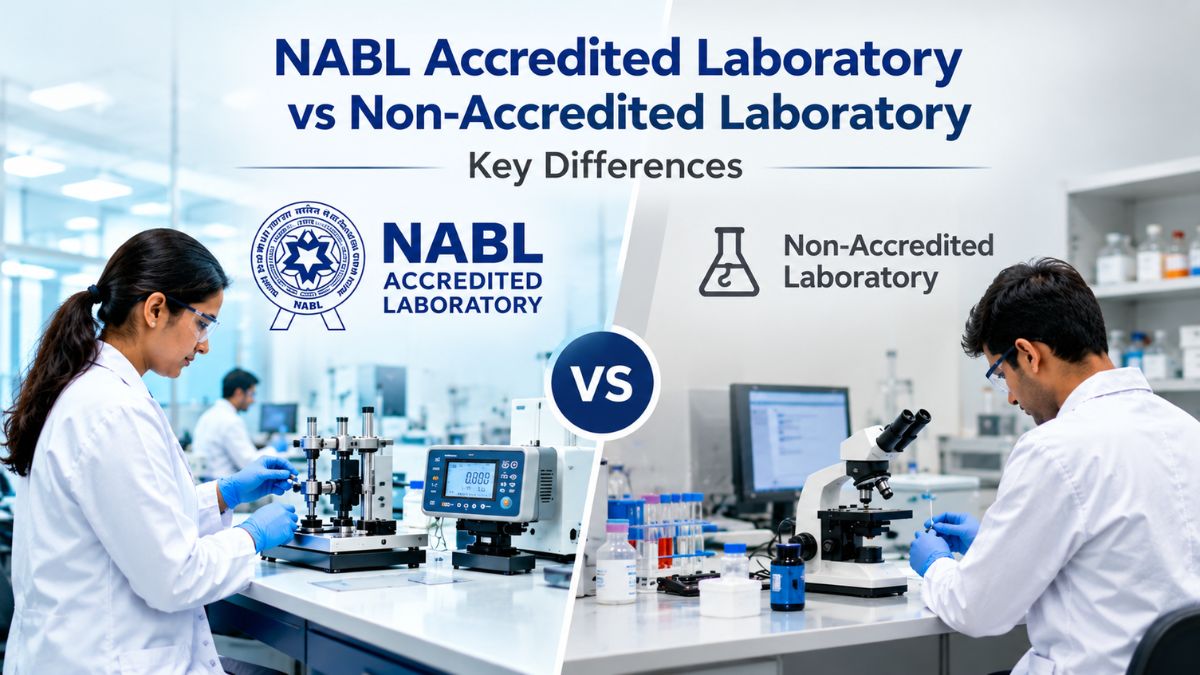
Laboratory testing and calibration play an important role in manufacturing, engineering, healthcare, construction, energy, research, and many other industries. The accuracy of a test result or calibration certificate can directly affect product quality, equipment performance, safety, and compliance. For this reason, businesses often compare accredited and non-accredited laboratories before selecting a service provider.
A NABL accredited laboratory has undergone an assessment of its competence against applicable accreditation requirements. In India, NABL provides accreditation to testing and calibration laboratories according to ISO/IEC 17025, while medical laboratories are accredited under ISO 15189. NABL accreditation involves third-party assessment of technical competence and relevant quality-management requirements.
Understanding the difference between accredited and non-accredited laboratories can help organizations make informed decisions when selecting testing or calibration services.
What Is a NABL Accredited Laboratory?
A NABL accredited laboratory is a laboratory that has been assessed and accredited by the National Accreditation Board for Testing and Calibration Laboratories for specific activities within its approved scope.
For testing and calibration laboratories, NABL uses ISO/IEC 17025, which covers general requirements for the competence of testing and calibration laboratories. NABL accreditation is not simply a general quality label; it relates to the laboratory’s demonstrated competence for the activities included in its accreditation scope.
The scope is important because a laboratory may be accredited for particular tests, measurements, instruments, ranges, or disciplines rather than automatically being accredited for every service it provides.
What Is a Non-Accredited Laboratory?
A non-accredited laboratory is a laboratory that does not hold NABL accreditation for the relevant testing or calibration activity.
This does not automatically mean that every result from a non-accredited laboratory is inaccurate. A laboratory may have qualified personnel, appropriate equipment, established procedures, and considerable experience without holding NABL accreditation.
However, customers may have less independent third-party evidence regarding the laboratory’s competence for a particular activity when compared with an appropriately scoped accredited laboratory.
The requirements of a particular project, customer, regulator, tender, or industry should therefore be considered before selecting a laboratory.
NABL Accredited vs Non-Accredited Laboratory
The key differences can be understood through several factors.
| Factor | NABL Accredited Laboratory | Non-Accredited Laboratory |
| Third-party accreditation | Assessed by NABL for its accredited scope | No NABL accreditation for the relevant activity |
| Standard | Testing/calibration generally assessed against ISO/IEC 17025 | May use internal or other quality systems |
| Scope | Specific accredited activities are defined | No NABL-accredited scope |
| Technical competence | Independently assessed within the accreditation process | Not independently demonstrated through NABL accreditation |
| Quality system | Relevant requirements are assessed | Depends on the laboratory’s own system |
| Recognition | Results may be more readily accepted where accreditation is required | Acceptance depends on customer or applicable requirements |
| Surveillance | NABL conducts surveillance as part of maintaining accreditation | No NABL surveillance |
| Suitability | Useful where accredited results are required | May be suitable where accreditation is not required |
The comparison should always be made according to the specific service required rather than assuming that accreditation covers every activity performed by a laboratory.
Why Is NABL Accreditation Important?
NABL describes accreditation as a way of assessing the technical competence of conformity assessment bodies. Its accreditation system for testing and calibration laboratories is based on ISO/IEC 17025.
For businesses, this can provide an additional level of confidence when selecting a laboratory for important testing or calibration work.
Accreditation can be particularly relevant when test or calibration results need to be submitted to customers, regulatory bodies, procurement organizations, or other stakeholders that specify accredited services.
It can also help organizations identify laboratories whose technical competence has been assessed for defined activities.
Understanding the Scope of Accreditation
One of the most important things to check before choosing a laboratory is its scope of accreditation.
NABL accreditation is location-specific, and accreditation is granted for defined scopes and disciplines. A laboratory operating from multiple locations may need separate accreditation arrangements for each location.
This means that simply seeing the words “NABL accredited” on a website is not enough.
Suppose a company needs calibration of a particular electrical measuring instrument. It should check whether the laboratory’s current NABL scope actually includes the relevant parameter, instrument, measurement range, and applicable conditions.
The same principle applies to testing laboratories. Accreditation for one type of test does not automatically mean accreditation for every possible test.
What Is a NABL Calibration Lab?
A NABL Calibration lab is a calibration laboratory accredited by NABL for specific calibration activities under ISO/IEC 17025.
Calibration compares the measurement performance of an instrument or device against an appropriate reference under specified conditions. Depending on the instrument and scope, calibration may involve parameters such as temperature, pressure, electrical measurements, dimensional measurements, mass, or other quantities.
For industrial organizations, calibration can help maintain confidence in measurement equipment used during production, inspection, quality control, research, and other operations.
When choosing a NABL calibration laboratory, businesses should check the laboratory’s accreditation scope and confirm that the required instrument and measurement range are included.
Difference in Quality Management
An important distinction between accredited and non-accredited laboratories is the independent assessment associated with accreditation.
NABL states that its accreditation process for testing and calibration laboratories covers technical competence and relevant quality-management requirements under ISO/IEC 17025.
A non-accredited laboratory may still operate with documented procedures and quality controls. However, those systems have not been assessed through NABL accreditation for the relevant scope.
Therefore, businesses should consider what level of documented and independently assessed competence their project requires.
Difference in Personnel Competence
Testing and calibration require trained personnel who understand measurement procedures, equipment, methods, uncertainty, environmental conditions, and technical requirements relevant to their work.
NABL’s assessment process includes evaluation of the technical competence of conformity assessment bodies. NABL also uses technical assessors with appropriate knowledge and experience to conduct assessments.
A non-accredited laboratory may also employ experienced professionals, but NABL accreditation provides an external assessment framework for the accredited activities.
Difference in Equipment and Measurement Processes
Laboratory equipment needs to be suitable for the measurements being performed and maintained appropriately.
For calibration work in particular, the suitability of reference standards, measuring equipment, environmental conditions, procedures, and measurement capabilities can affect the reliability of results.
A NABL-accredited laboratory operates within its assessed scope and applicable requirements. However, customers should still check the actual scope and certificate details rather than assuming that every instrument or parameter is covered.
When Should You Choose a NABL Accredited Laboratory?
A NABL accredited laboratory can be particularly relevant when:
- A customer specifically requires NABL-accredited results.
- A tender or contract specifies accredited testing or calibration.
- Regulatory or industry requirements call for accredited services.
- Test or calibration results are important for quality documentation.
- Measurement traceability and technical competence need independent assessment.
- Results may be shared with multiple stakeholders.
NABL itself notes that accredited laboratory results are used by regulators and other organizations in areas where credible conformity assessment is important.
Can a Non-Accredited Laboratory Still Be Useful?
Yes. Accreditation is not automatically required for every laboratory service.
Some organizations may use internal laboratories or non-accredited service providers for routine activities where accreditation is not specified. The suitability of such a laboratory depends on the customer’s requirements, the nature of the measurement or test, applicable standards, and the level of confidence needed.
For critical testing or calibration, however, organizations should carefully evaluate the laboratory’s technical capabilities and documentation.
The decision should therefore be based on the requirements of the particular application rather than accreditation status alone.
How to Verify a NABL Accredited Laboratory
Before engaging a laboratory, customers should verify its accreditation status through NABL’s official laboratory search.
NABL explains that users can search for accredited testing, calibration, medical laboratories, proficiency testing providers, and reference material producers through its website. The search can also be filtered by location and other criteria.
More importantly, compare the required service with the laboratory’s current scope of accreditation.
Check:
- Laboratory name and location
- Accreditation certificate details
- Relevant testing or calibration discipline
- Specific parameter or measurement
- Measurement range where applicable
- Current validity/status
- Any applicable limitations or conditions
This helps ensure that the service you are ordering actually falls within the laboratory’s accredited scope.
NABL Accreditation and International Recognition
NABL maintains international linkages through organizations including the International Laboratory Accreditation Cooperation (ILAC) and the Asia Pacific Accreditation Cooperation (APAC). NABL states that these arrangements support acceptance of test and calibration results across borders within applicable frameworks.
For companies involved in exports, international supply chains, or customers located outside India, this can be an important consideration. However, acceptance always depends on the applicable requirements and the specific scope of accreditation.
What Businesses Should Check Before Selecting a Laboratory
Rather than selecting a laboratory based only on the phrase “NABL accredited,” businesses should consider the complete service requirement.
First, identify exactly what needs to be tested or calibrated. Then determine the required standard, measurement range, accuracy, reporting format, turnaround time, and documentation.
After that, verify whether the laboratory’s accreditation scope covers the required activity.
Cost can also be considered, but it should not be evaluated separately from technical requirements. A lower-cost service may not meet the documentation or accreditation requirements of a particular project.
Final Thoughts
The primary difference between a NABL accredited and non-accredited laboratory is the independent accreditation framework and the defined scope within which competence has been assessed.
A NABL accredited laboratory working within its accredited scope provides customers with evidence that the relevant laboratory activities have been assessed against applicable requirements. For testing and calibration laboratories, NABL uses ISO/IEC 17025 as the applicable accreditation standard.
A non-accredited laboratory may still have experienced personnel, suitable equipment, and effective procedures, but it does not have NABL accreditation for the relevant activity.
For businesses looking for testing or calibration services, the most important step is to verify the exact accreditation scope and match it with the required service. This is particularly important when selecting a NABL Calibration lab or a nabl accredited laboratory in India for work where documented technical competence and acceptance of results are important.
Frequently Asked Questions
1. What is a NABL accredited laboratory?
A NABL accredited laboratory is a laboratory whose specified testing or calibration activities have been assessed and accredited by NABL against applicable requirements. Testing and calibration laboratories are accredited under ISO/IEC 17025.
2. Is every service offered by a NABL laboratory accredited?
No. NABL accreditation applies to a defined scope. Customers should verify whether the specific test, calibration parameter, instrument, range, or discipline is included in the laboratory’s current scope.
3. What is a NABL Calibration lab?
A NABL Calibration lab is a calibration laboratory accredited by NABL for specified calibration activities under ISO/IEC 17025.
4. Are non-accredited laboratory results always inaccurate?
No. A non-accredited laboratory may have qualified staff and appropriate equipment. However, it does not have NABL accreditation for the relevant activity, so customers should evaluate its capabilities according to their requirements.
5. How can I find a NABL accredited laboratory in India?
NABL provides an online search facility for accredited laboratories. Users can search by laboratory type and use filters such as state and city to identify relevant facilities.
.png)